Launch offer — valid today only

📄 Digital book in PDF · read it on your phone or print it

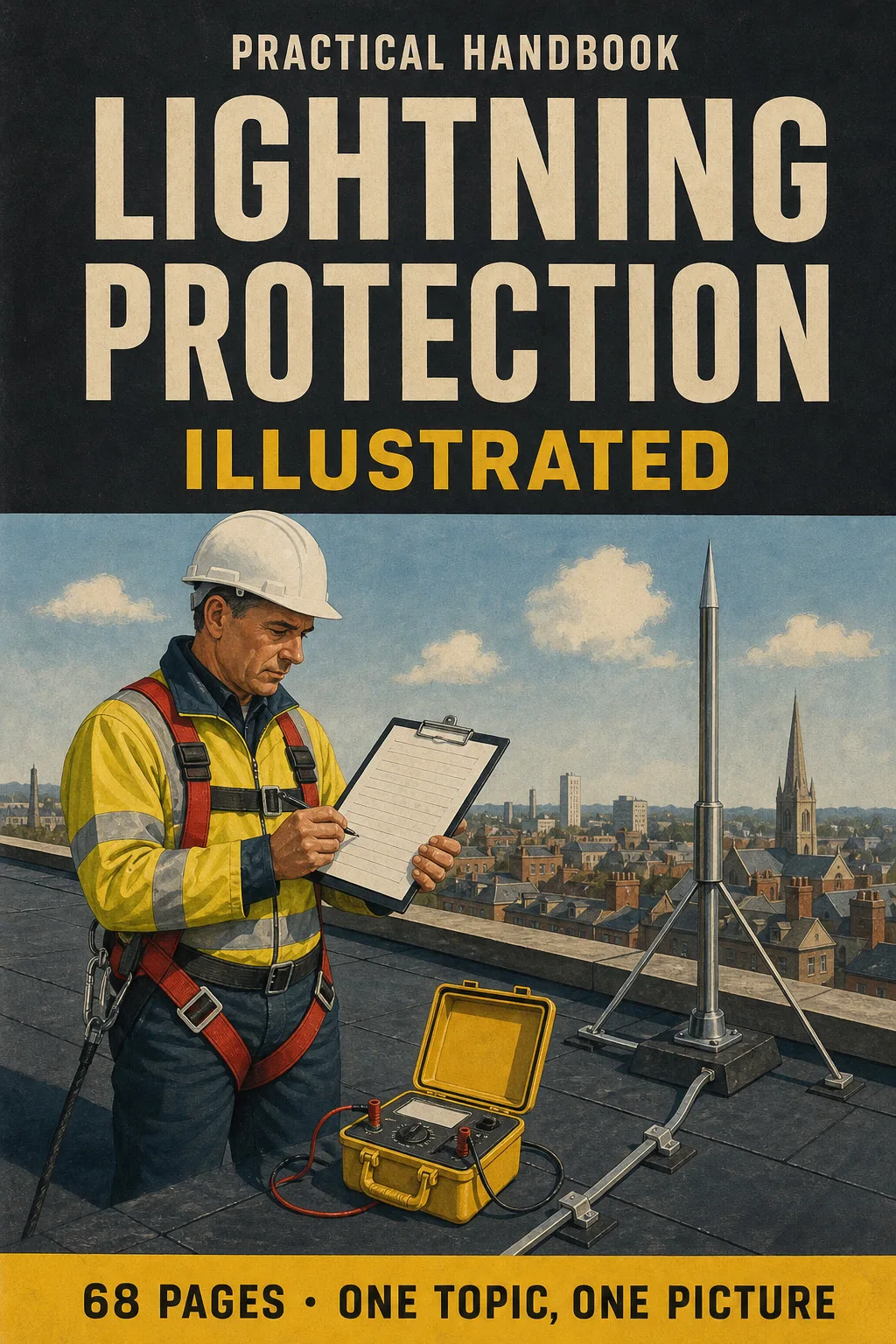
Lightning Protection and BS EN 62305 in Drawings Make the Call on Site Without Going Back to the Standard

The path of a strike, the rolling sphere, down conductors and the test joint, separation distance, earth electrodes, bonding and SPDs, the earth test and the roof-to-earth inspection. Each topic has its own page: the drawing first, then what you need to remember. 68 illustrated pages.

YES, I WANT LIGHTNING PROTECTION ILLUSTRATED

🔒 Secure checkout · PDF by email · 30-day guarantee

Every topic, its own pageEach rule drawn, with the explanation beside it
68 illustrated pages9 parts, from the path of a strike to the numbers to keep in the van
Up-to-date sourcesBS EN 62305 series, BS 7430 and BS 7671
PDF by emailFormat

Look Inside the Book

Every page has one large drawing and a box with the numbers and steps you need to know:

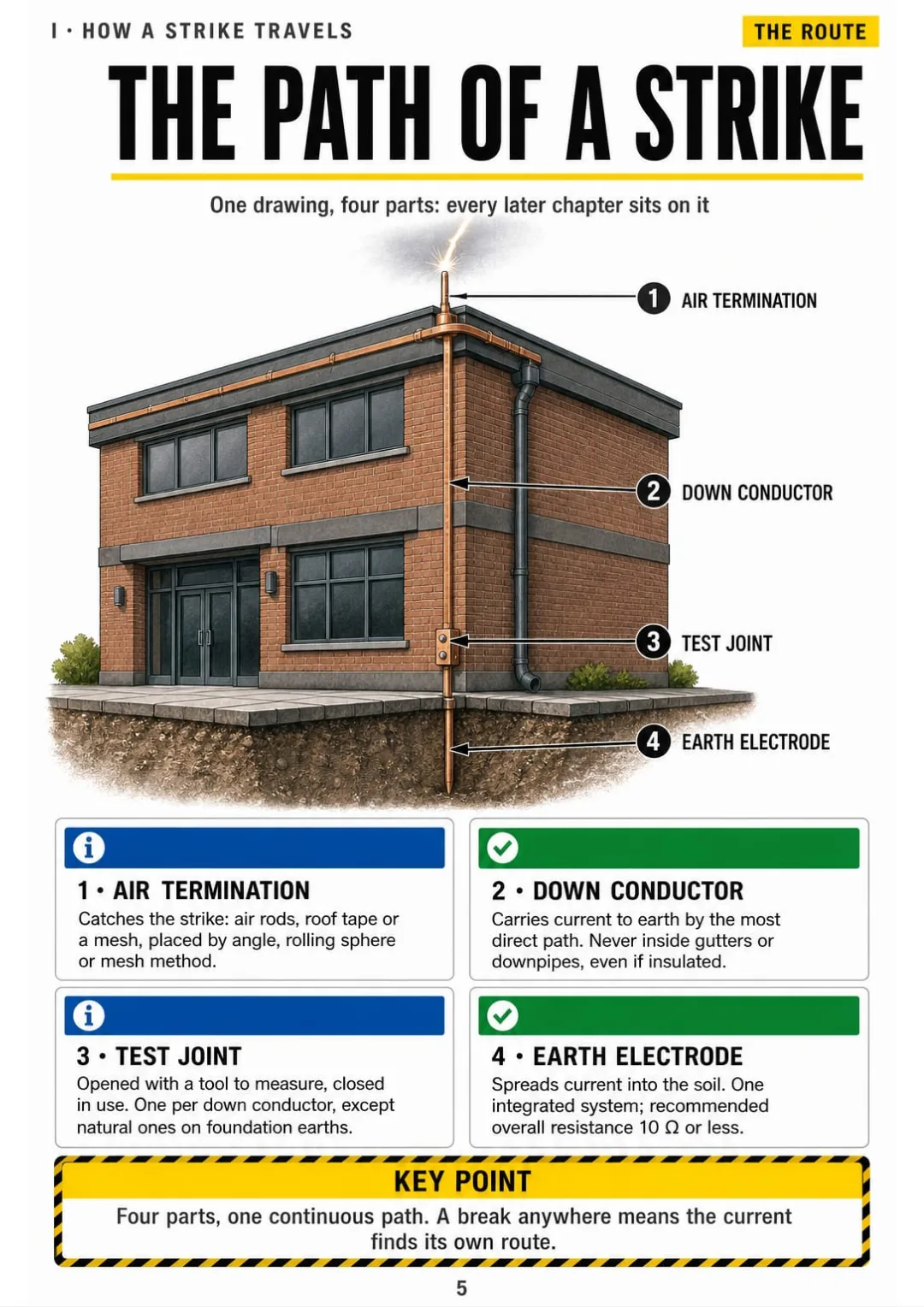
The full route of a strike: air termination, down conductor, test joint, earth electrode.
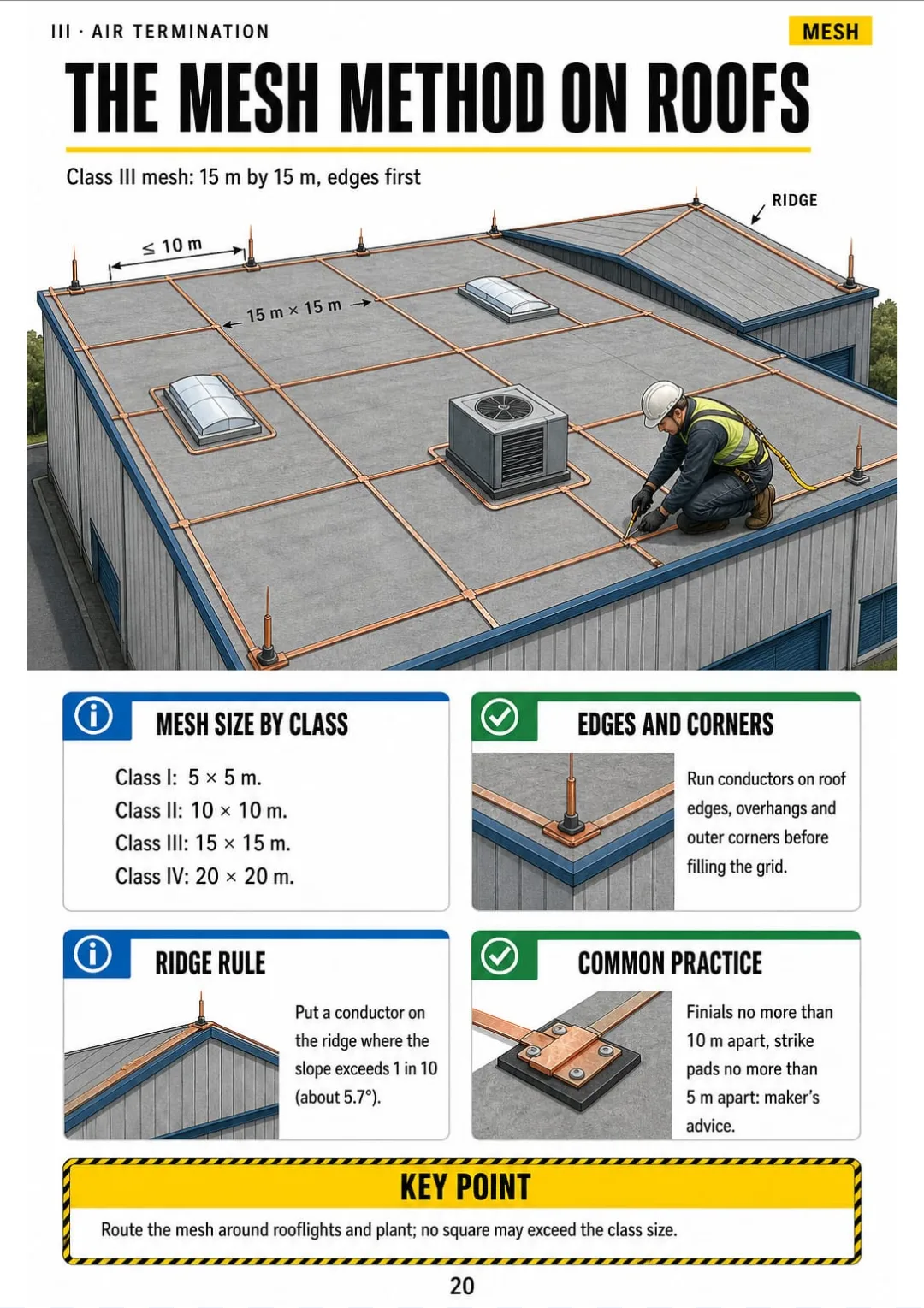
Class III mesh of 15 × 15 m, with ridge conductors above a 1 in 10 slope.
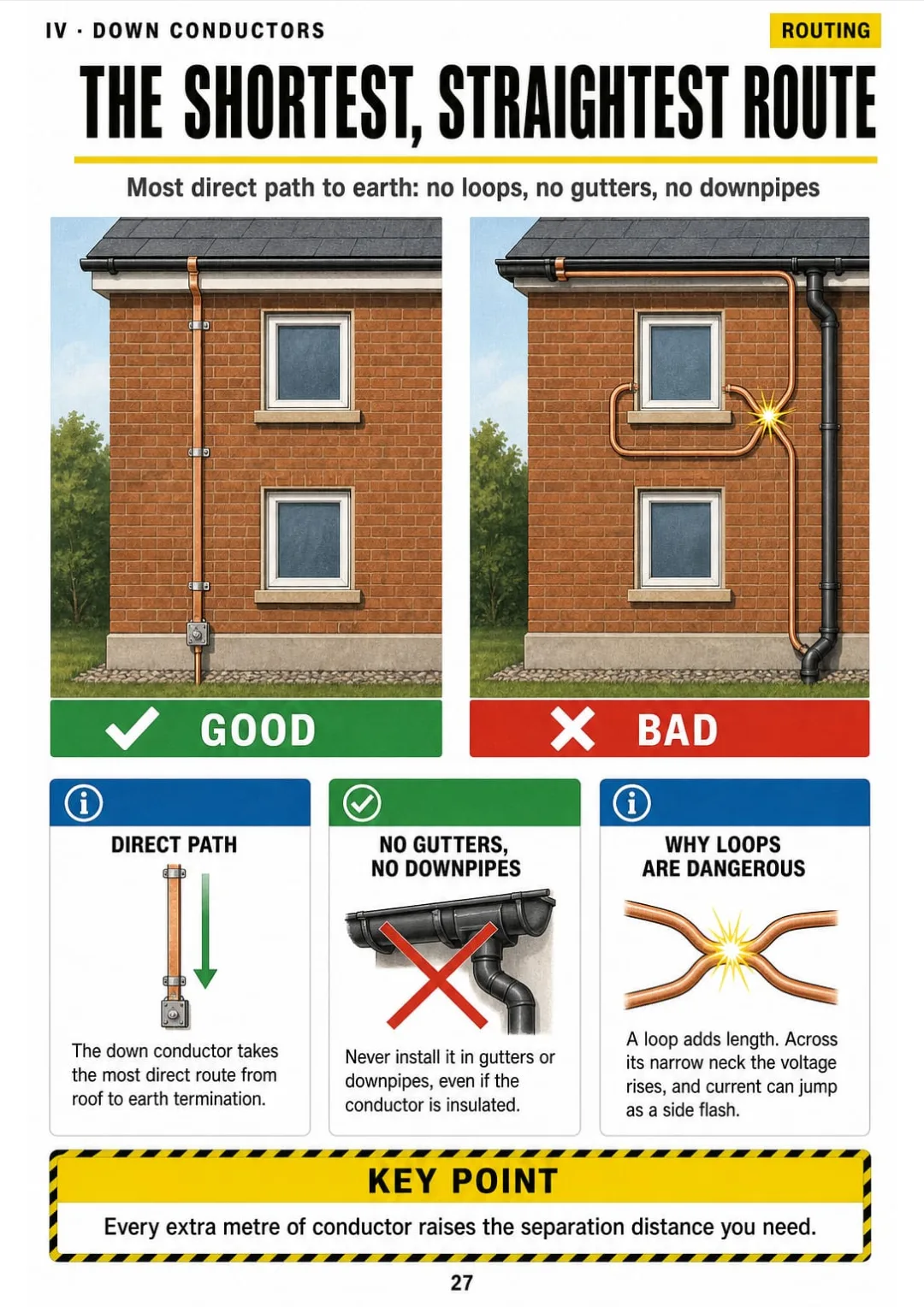
Straight down the wall, never in a gutter or downpipe, never in a loop
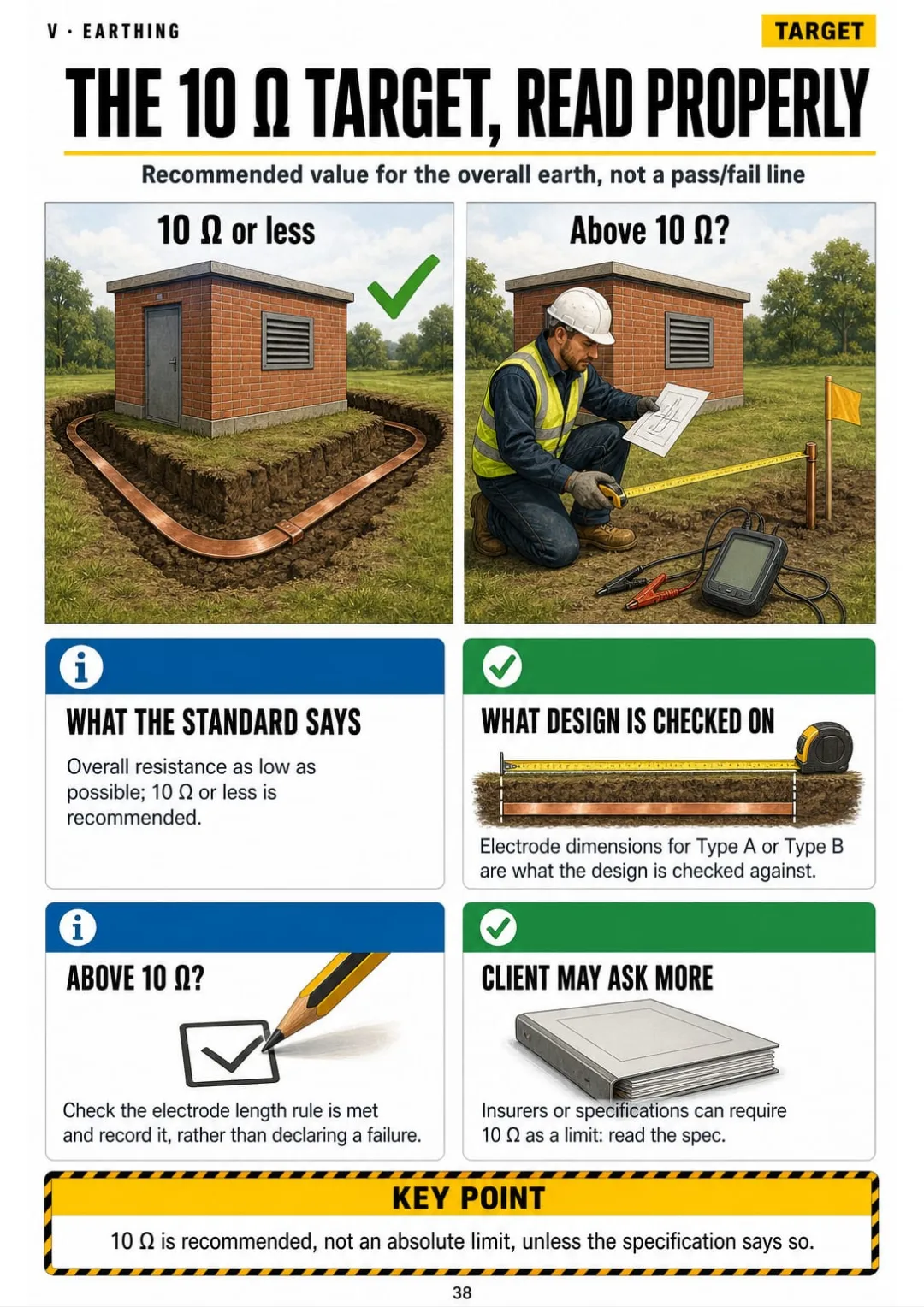
10 Ω or less is recommended; the electrode length rule is the design check
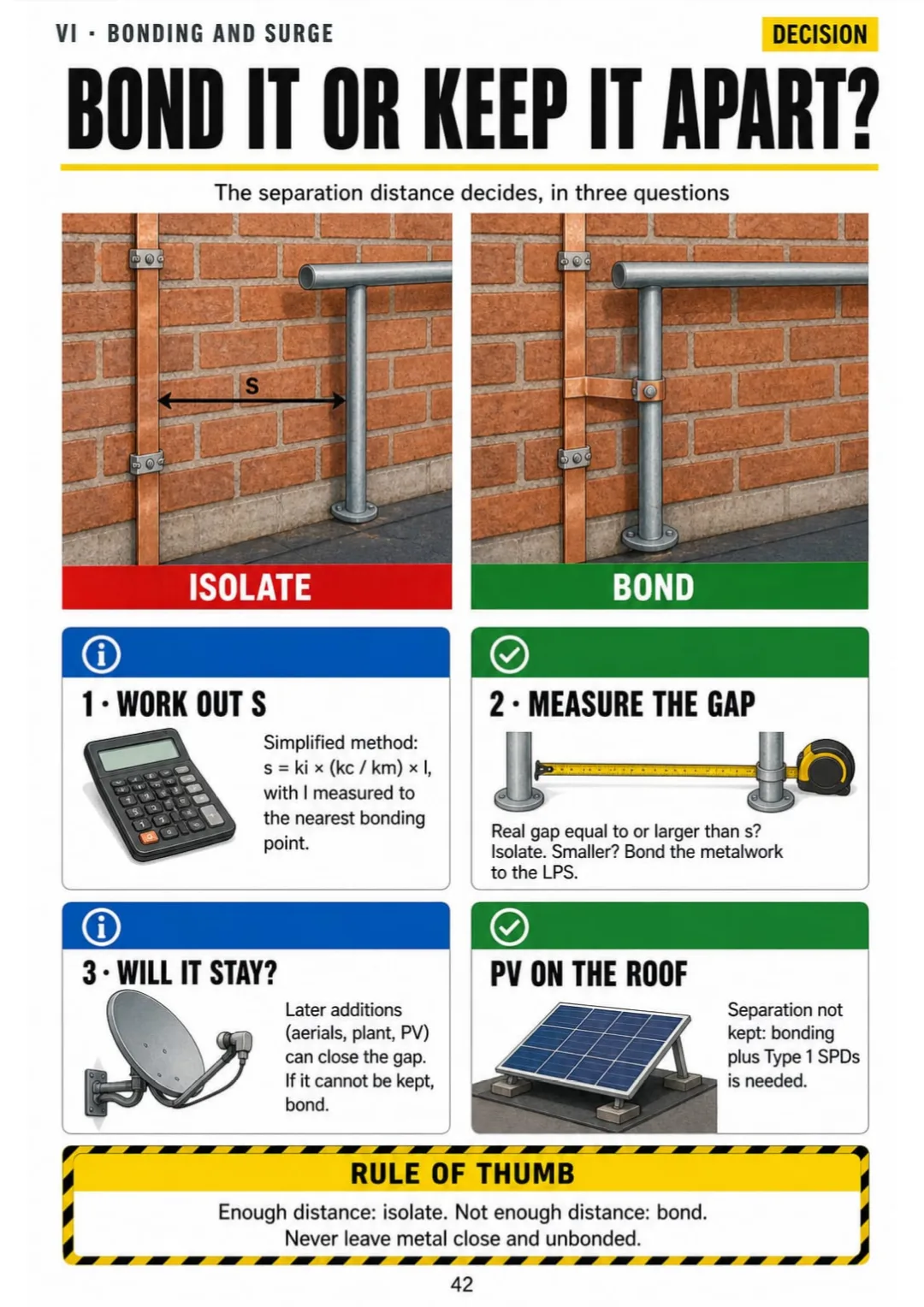
Gap ≥ s: isolate. Gap < s: bond, and add Type 1 SPDs where services are involved.
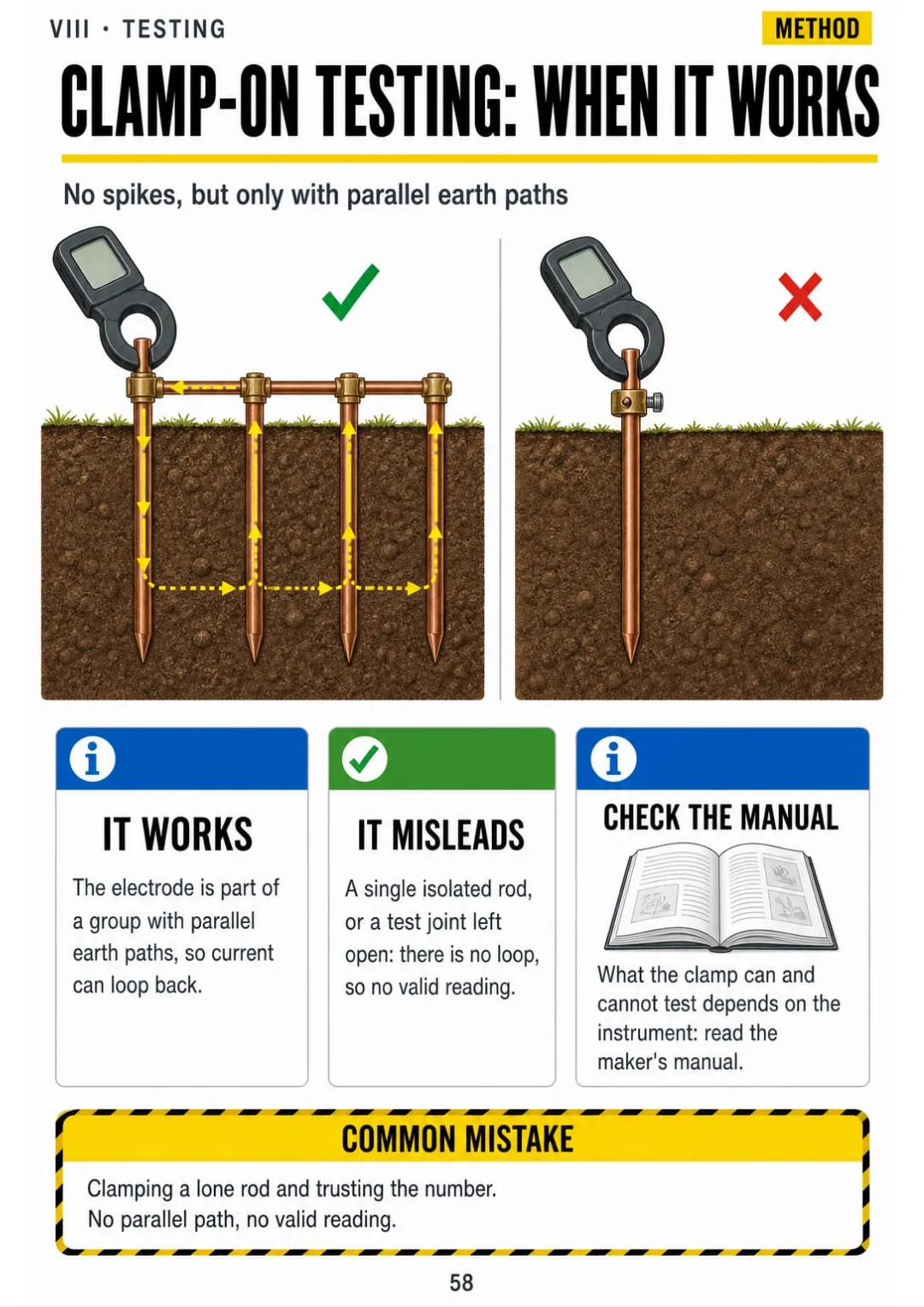
Clamp-on testing: valid on a parallel group, misleading on a single isolated rod.
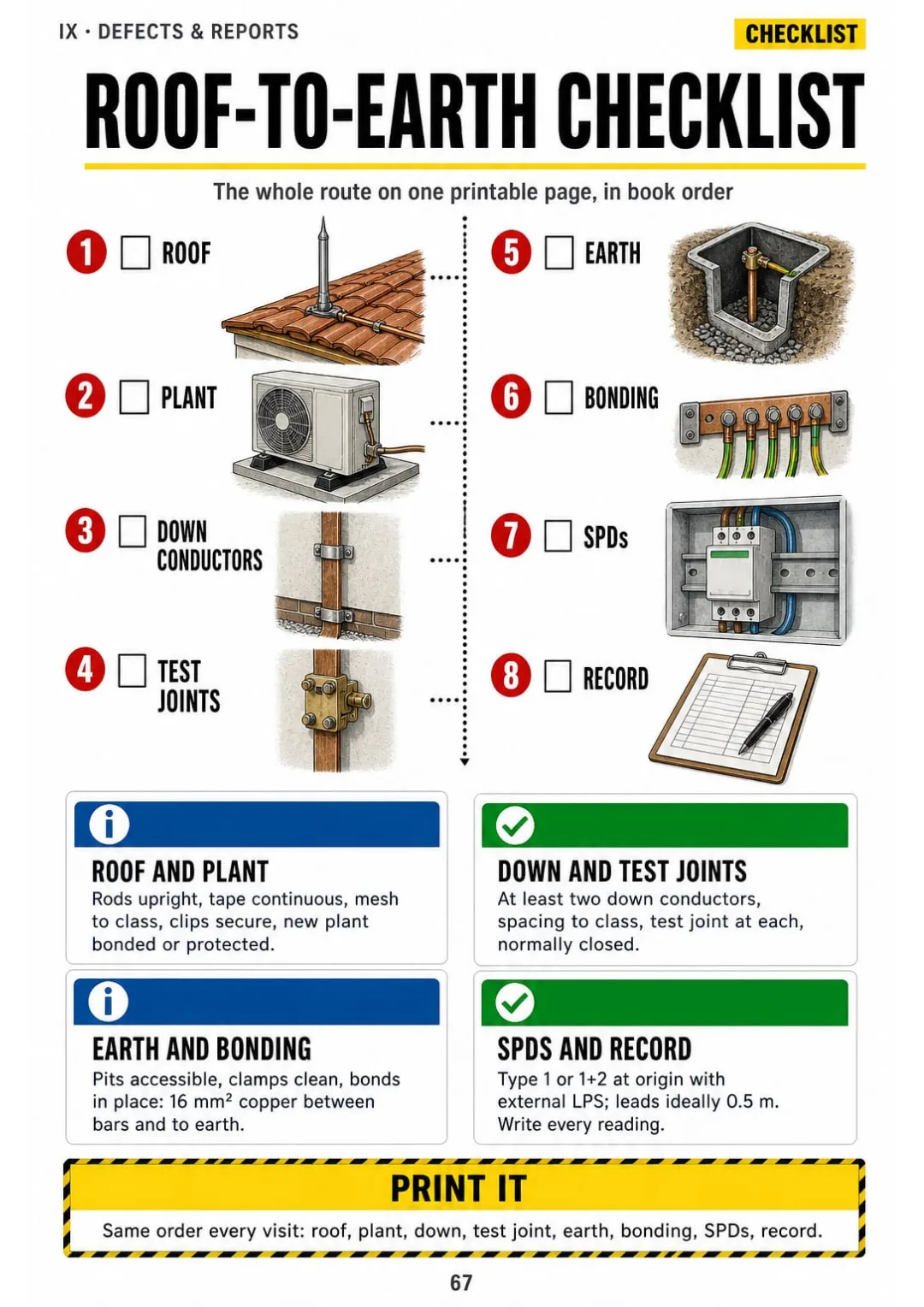
8 tick boxes from roof to record, in the same order as the book
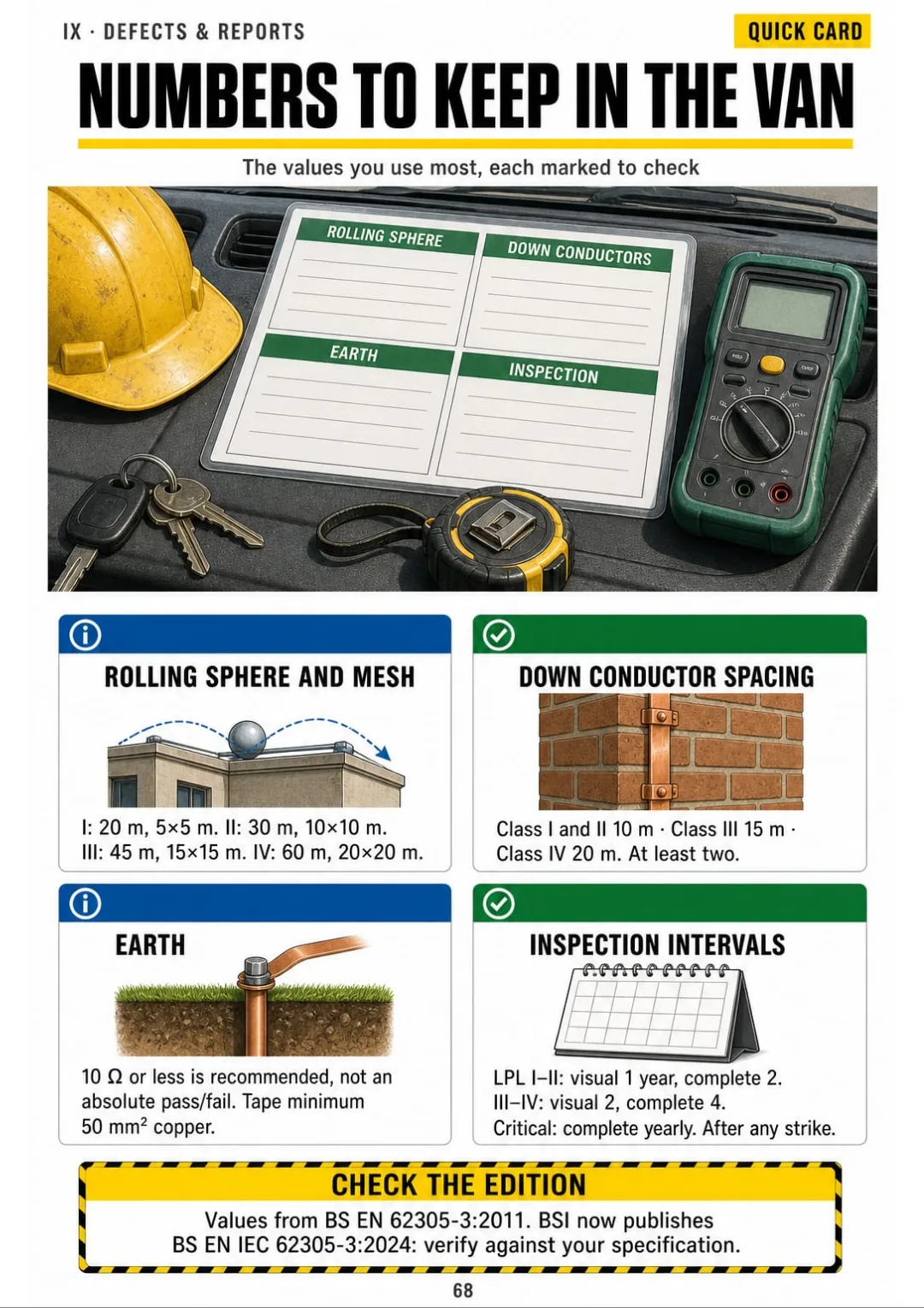
Sphere 20/30/45/60 m, mesh 5–20 m, spacing 10/10/15/20 m, 10 Ω recommended

Swipe to see more →

These are real pages from the book. The table of contents is the full one: 9 parts and 64 topics.

The Problem Isn't You. It's How It Was Explained to You.

You're on a flat roof. A new steel handrail runs a short way from the down conductor, and you have to decide whether to bond it or keep it clear.

The standard gives you separation distance as a formula, with the factors spread across clauses and tables. You go through it twice and still aren't sure which numbers apply to this building.

Straight down the wall, never in a gutter or downpipe, never in a loop

In this book it's one page: the building drawn, Class III, four down conductors, l = 10 m, and the working laid out line by line. The answer sits in a box: s ≈ 0.18 m in air.

The rolling sphere, the test joint, the 10 Ω target, bonding versus isolating and where each SPD goes work the same way: each one has its own page and its own drawing.

You look at the worked example, measure the gap on the roof and make the call without going back to the standard.

COMPARE FOR YOURSELF

The Same Topic, Two Ways to Learn It

THIS
  • The standard: line after line
  • Rolling sphere and protective angle explained in words alone
  • You get to the job still unsure
The method by which the protected volume is established requires the designer to consider the geometry of the whole structure in relation to an imaginary sphere, the size of which varies with the level of protection selected, and to identify each location at which that sphere would touch the building, every one of which must then be served by an air-termination conductor; where vertical rods are used, further account must be taken of the extent to which the sphere dips into the space between adjacent rods, since this dip in turn governs the minimum height needed for those rods to remain effective across the roof.
FOR THIS
  • The rolling sphere in one drawing
  • The radii and the sag in a box
  • You see it and it makes sense
Class III mesh of 15 × 15 m, with ridge conductors above a 1 in 10 slope.
CONTENTS

Take a Look at the 9 Parts and 64 Topics

How a strike travels, standards and risk, air termination, down conductors, earthing, bonding and surge protection, inspection, testing, and defects and reports: 68 pages, all illustrated.

IHow a Strike Travels · pp. 5-10
  1. The path of a strike: roof to earth
  2. What a flash actually does
  3. Direct strike, nearby strike, strike to a service
  4. External and internal protection: two halves of one system
  5. Lightning Protection Zones in one drawing
  6. What the old BS 6651 did differently
IIStandards, Risk and Class · pp. 11-16
  1. The four parts of BS EN 62305 on one page
  2. Risk assessment in plain steps
  3. Collection area: a worked example
  4. Lightning Protection Levels I to IV
  5. Class of LPS and the numbers that follow it
  6. Other UK rules on the same job
IIIAir Termination · pp. 17-25
  1. Three ways to place air terminations
  2. The rolling sphere: roll the ball over the drawing
  3. The protective angle: a worked example
  4. The mesh method on flat and pitched roofs
  5. Natural air terminations: metal roofs and parapets
  6. Roof plant, aerials and solar panels
  7. Spires, towers and chimneys
  8. Conductor sizes and materials
  9. Fixings, expansion and supports
IVDown Conductors and Separation · pp. 26-32
  1. How many down conductors, and where
  2. The shortest, straightest route
  3. Natural down conductors: steel frames and rebar
  4. The test joint
  5. Separation distance: what it is
  6. Separation distance: a worked example
  7. Protection against touch and step voltage
VEarthing · pp. 33-40
  1. Why the earth electrode matters most
  2. Type A arrangement: rods and radials
  3. Type B arrangement: the ring earth
  4. Foundation earth electrodes
  5. Soil resistivity in ohm-metres
  6. The 10 Ω target and what it really says
  7. Rods, couplers and driving depth
  8. Earth pits and inspection chambers
VIBonding and Surge Protection · pp. 41-47
  1. Lightning equipotential bonding
  2. Bonding versus isolating
  3. Joining dissimilar metals
  4. SPD Type 1, Type 2, Type 3
  5. Where each SPD goes
  6. Keeping SPD leads short
  7. Data, telecom and other incoming lines
VIIInspection from Roof to Earth · pp. 48-54
  1. Visual inspection and full inspection
  2. Before you go up: drawings and safety
  3. Step 1: air terminations and roof conductors
  4. Step 2: roof plant and later additions
  5. Step 3: down conductors and fixings
  6. Step 4: test joints and ground level
  7. Step 5: earth pits and bonding
VIIITesting · pp. 55-62
  1. Test instruments and what each one reads
  2. Earth test at the test joint in 5 steps
  3. Fall-of-potential method
  4. Clamp-on (stakeless) testing
  5. Continuity of conductors and bonds
  6. Overall earth: combining the readings
  7. A reading looks wrong: what to check first
  8. Filling in the test record
IXDefects, Reports and Revision · pp. 63-68
  1. The most frequent roof defects
  2. The most frequent ground-level defects
  3. Writing the report for the client
  4. Remedial work: in what order
  5. Roof-to-earth checklist
  6. Numbers to keep in the van

One Page, One Topic, All Clear

Think of it this way:

You're standing at a test joint with the earth tester in your hand, the facilities manager beside you, and the reading has to go on the record now.

You open the page on the earth test at the joint and see the five steps drawn in order, the same order every time, with a worked reading in ohms beside them.

Gap ≥ s: isolate. Gap < s: bond, and add Type 1 SPDs where services are involved.

Then the next question comes: the reading is over 10 Ω. You turn to the earthing page and see what that figure means, and what to check before you write fail.

Lightning Protection Illustrated is 9 parts and 64 topics, all drawn, ending with the most frequent defects, a roof-to-earth checklist and the numbers to keep in the van.

What you see drawn, you don't have to memorize.

What's Inside Lightning Protection Illustrated:

Ipp. 5-10

How a Strike Travels

The route from roof to earth, what a flash does, direct and nearby strikes, external and internal protection, protection zones and what changed from BS 6651.

IIpp. 11-16

Standards, Risk and Class

The four parts of BS EN 62305, risk assessment in plain steps, collection area worked through, protection levels I to IV and the numbers that follow each class.

IIIpp. 17-25

Air Termination

Rolling sphere, protective angle and mesh, natural air terminations, roof plant and solar panels, spires and chimneys, conductor sizes, fixings and expansion.

IVpp. 26-32

Down Conductors and Separation

How many down conductors and where, the straightest route, steel frames and rebar, the test joint, separation distance worked through, touch and step voltage.

Vpp. 33-40

Earthing

Type A and Type B arrangements, foundation electrodes, soil resistivity in ohm-metres, what the 10 Ω target really says, rods, couplers and earth pits.

VIpp. 41-47

Bonding and Surge Protection

Equipotential bonding, bonding versus isolating, dissimilar metals, SPD Types 1, 2 and 3, where each one goes, short leads and incoming data lines.

VIIpp. 48-54

Inspection from Roof to Earth

Visual and full inspection, drawings and safety before you go up, then five steps from the air terminations down to the earth pits and bonding.

VIIIpp. 55-62

Testing

Test instruments, the earth test at the joint in 5 steps, fall-of-potential, clamp-on testing, continuity, overall earth, odd readings and the test record.

IXpp. 63-68

Defects, Reports and Revision

The most frequent roof and ground-level defects, the report for the client, remedial work in order, the roof-to-earth checklist and the numbers for the van.

At the end of the book: A roof-to-earth checklist, the most frequent defects drawn, and the numbers to keep in the van.
Plus: 2 Free Books

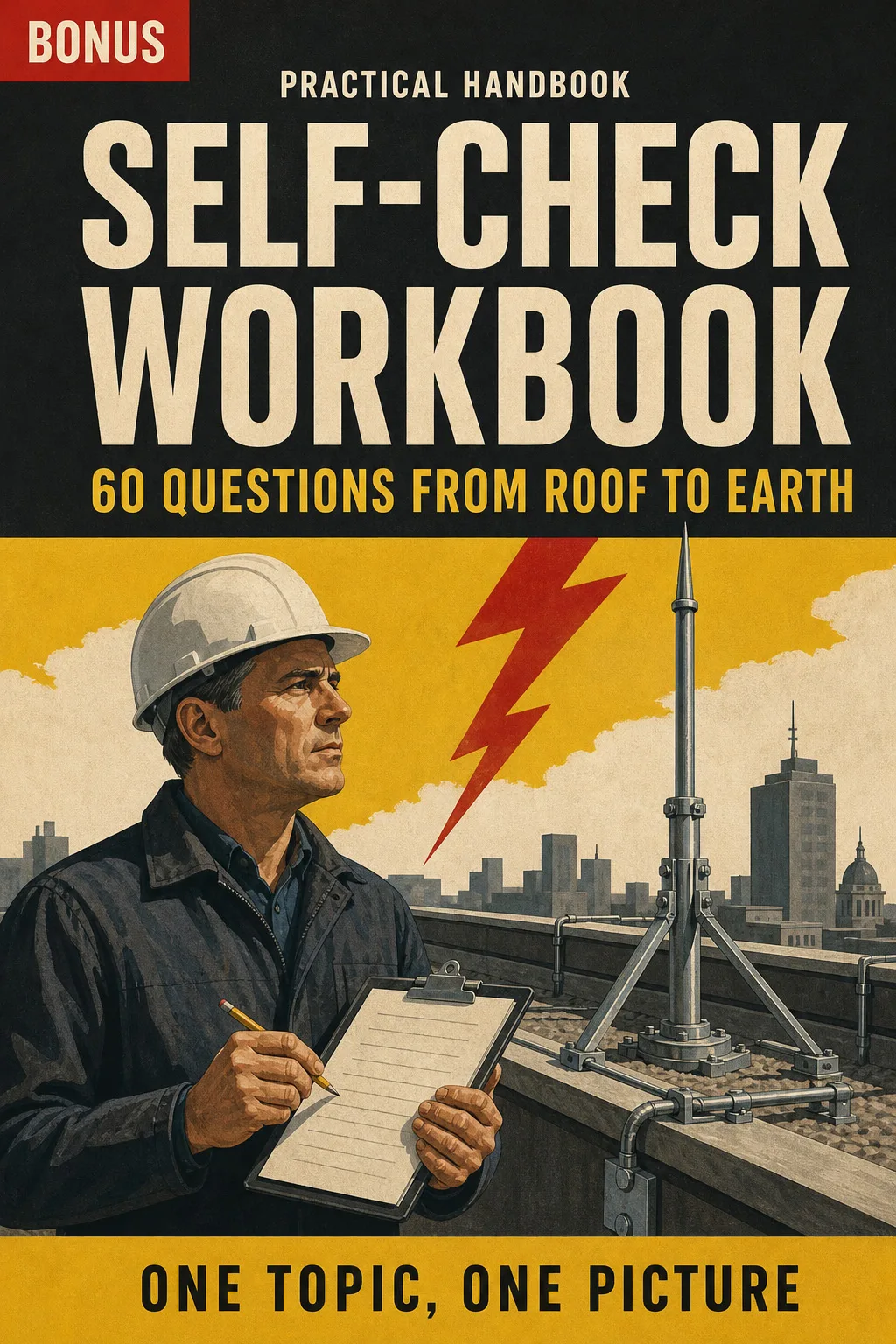
Self-Check Workbook: 60 Questions from Roof to Earth

BONUS 1: «Self-Check Workbook: 60 Questions from Roof to Earth»

Value on its own: US$ 17.90

Check yourself on air terminations, test joints, bonding and earth readings, with every answer explained next to a drawing.

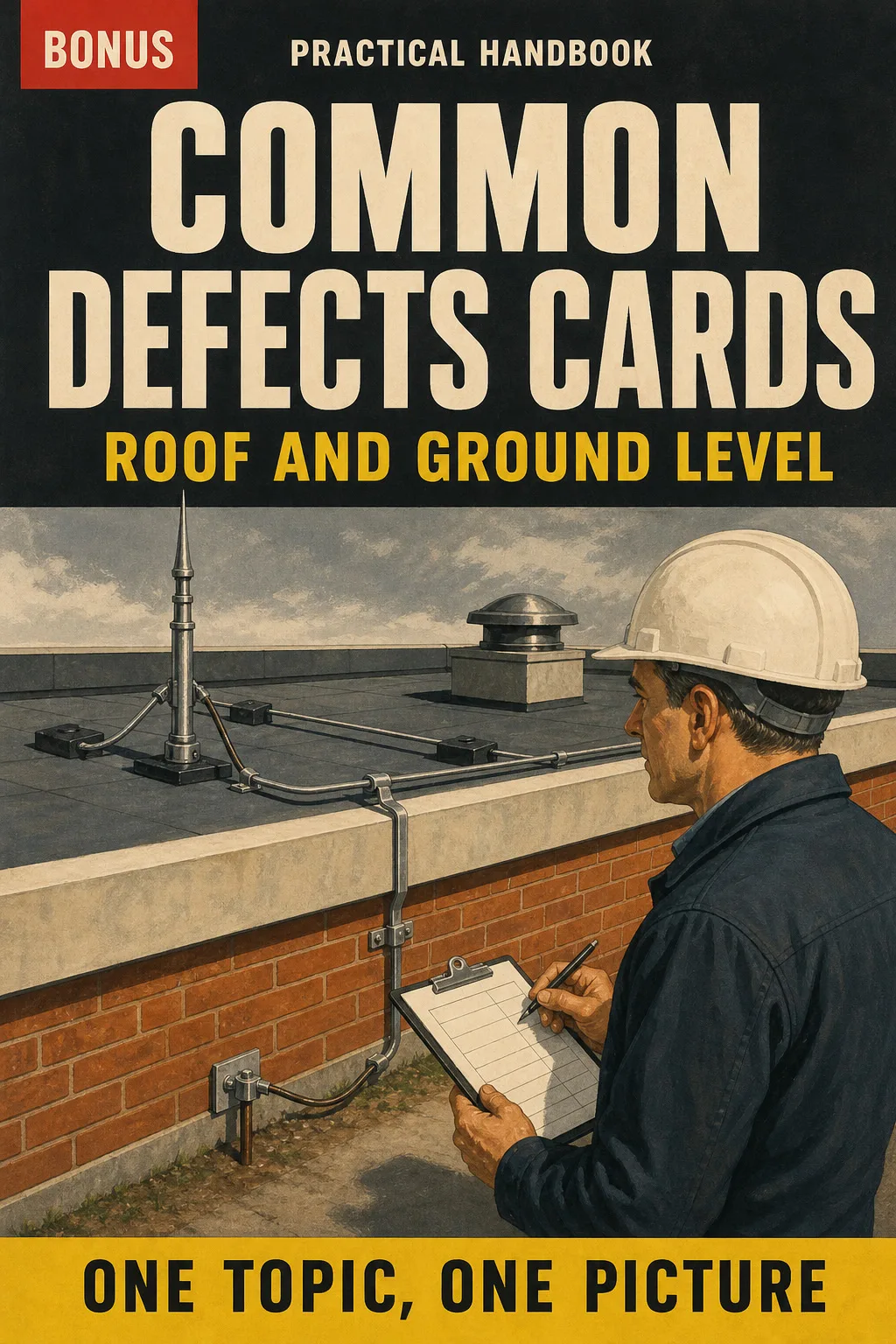
Common Defects Cards: Roof and Ground Level

BONUS 2: «Common Defects Cards: Roof and Ground Level»

Value on its own: US$ 14.90

The most frequent defects on roofs and at ground level, drawn wrong and right side by side, to print and keep in the van.

Lightning Protection Illustrated with 2 Free Books

  • Lightning Protection Illustrated: 68 illustrated pagesUS$ 63
  • BONUS 1: Self-Check Workbook: 60 Questions from Roof to EarthUS$ 17.90
  • BONUS 2: Common Defects Cards: Roof and Ground LevelUS$ 14.90
  • High-resolution PDF to printIncluded
Total value US$ 95.80
YOUR PRICE:
US$ 27
You save US$ 68.80
YES, I WANT LIGHTNING PROTECTION ILLUSTRATED FOR US$ 27

📄 This is a digital PDF book sent to your email: nothing is printed or shipped.

Secure purchaseEncrypted payment30-day guarantee

PDF by email: We email you Lightning Protection Illustrated as a PDF, together with the two free books. It's a single payment: no installments, no extra charges.

Who This Book Is For

You're taking on lightning protection work

You're taking on lightning protection work

If you're an electrician moving into lightning protection, you get the whole system in order, roof to earth, with every rule drawn instead of buried in clauses.

You inspect and test on site

You inspect and test on site

If you're a lightning protection engineer or steeplejack, you've done this for years: here the earth test, continuity and the test record sit in the same order every time, printed and kept in the van.

You sign off the building's inspection

You sign off the building's inspection

If you're a facilities manager, you see what the inspection should cover and can read the test record with confidence.

Everything You Get Today

US$ 95.80US$ 27
YES, I WANT LIGHTNING PROTECTION ILLUSTRATED FOR US$ 27

📄 This is a digital PDF book sent to your email: nothing is printed or shipped.

30DAYS
GUARANTEE

30-Day Guarantee

Try Lightning Protection Illustrated for 30 days, bonus books included.

We refund everything if the file won't open, if the book isn't what you see here, if you were charged twice or if the email doesn't arrive. Just email us.

You pay once. No subscriptions.

Frequently Asked Questions

Is it for me if I've been doing lightning protection for years?

Yes. It isn't a beginner's course: it puts the whole system in one order, roof to earth, so you can check a detail quickly or explain it to a client with a drawing.

Where does the content come from?

It's written for UK work and checked against the BS EN 62305 series (Parts 1–4), with BS 7430 for earthing, BS EN 62561 for components and BS 7671 for surge protection. Every threshold, interval and clause reference is marked so you can check it against the edition in force.

Is it official material?

No. It's an independent illustrated book. It isn't affiliated with or endorsed by BSI or any trade association, and it doesn't reproduce the text or tables of the standards.

Does it replace training?

No. It doesn't replace training, the standards themselves or a site risk assessment. You don't need to work on supply or high-voltage systems to use it: it covers the lightning protection system itself and the earth test at the joint. Fitting SPDs inside the installation is an electrician's job under BS 7671, and work at height is covered in outline only.

Do I get a certificate, and are the practice questions from an exam?

No certificate: it's a study and reference book, not a course. The 60 questions in the workbook are written for this book to help you check yourself. They aren't official questions from any exam or assessment.

When and how does it arrive?

As a PDF by email, together with the 2 free books, to the address you enter at checkout.

Do I have to pay every month?

No. It's a one-off payment, with no subscription.

Can I have it on paper?

Yes. The PDF is laid out to print, at home or at a print shop, so you can keep it in the van and take it on site.

How does the refund work?

You have 30 days. We refund everything if the file won't open, if the book isn't what you see on this page, if you were charged twice or if the email doesn't arrive: just email us.

Before You Close This Page

No more rereading the standard and getting nothing from it.

Separation distance: you see it drawn, and that's it.

You get to the job knowing where everything is.

Drawings make studying faster.

The book is right below.

One-time payment: US$ 27 · Guarantee: 30 days · PDF by email

YES, I WANT LIGHTNING PROTECTION ILLUSTRATED FOR US$ 27

📄 This is a digital PDF book sent to your email: nothing is printed or shipped.